Spend $50, get $25 OFF — applied automatically.
Skip to Content Skip to Navigation Skip to Footer
Join Membership
Season 2 ·

S2E23 – Different Hard Drive Types for Music Producers
0:00 / 0:00
This media could not be played.

Never Miss an Episode

Get new podcast episodes delivered to your inbox.
Home/Podcast/S2E23 – Different Hard Drive Types...
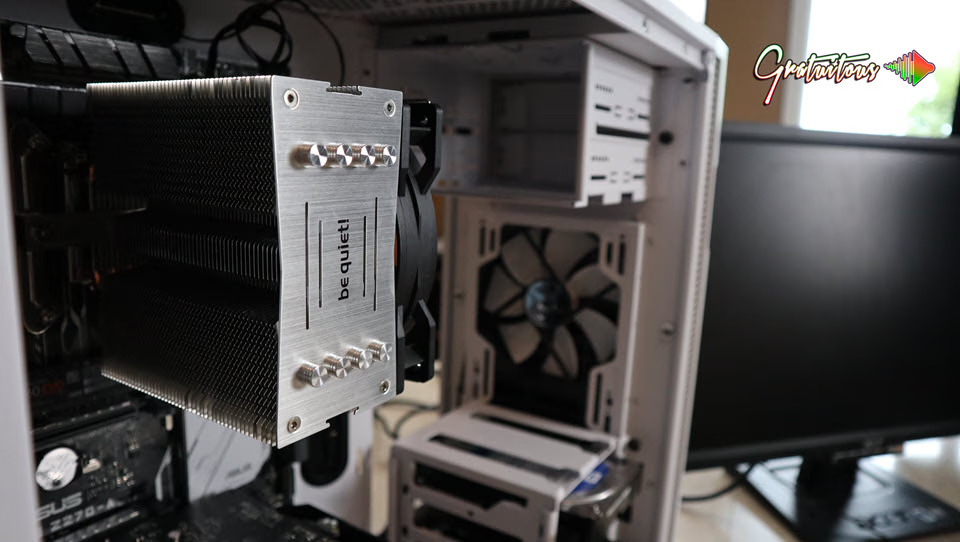
GratuiTous-Music-Production-Computer-2017
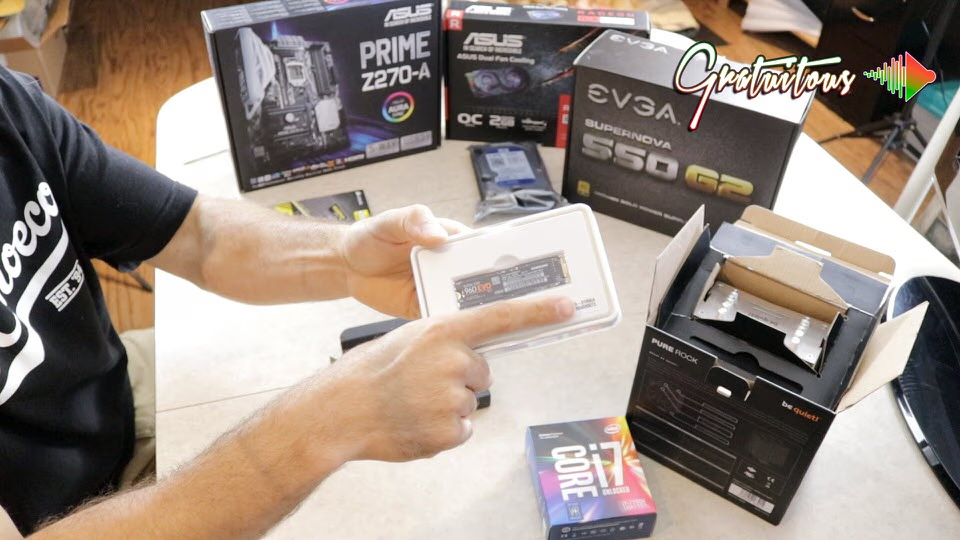
My custom music production computer from 2017!

In this podcast episode of Music Production Made Simple, I discuss hard drives with you for your music production computer.

Here’s more details on my music computer:

There’s two main hard drives we use for our music production computers..

That is Mechanical Hard Drives (HDD), and Solid State Hard Drives (SDD). There are also what’s called a “hybrid hard drive” where there’s a small amount of SSD built into a Hard Drive to help it run a little faster by “caching” common files for faster loading.

Mechanical Hard Drives
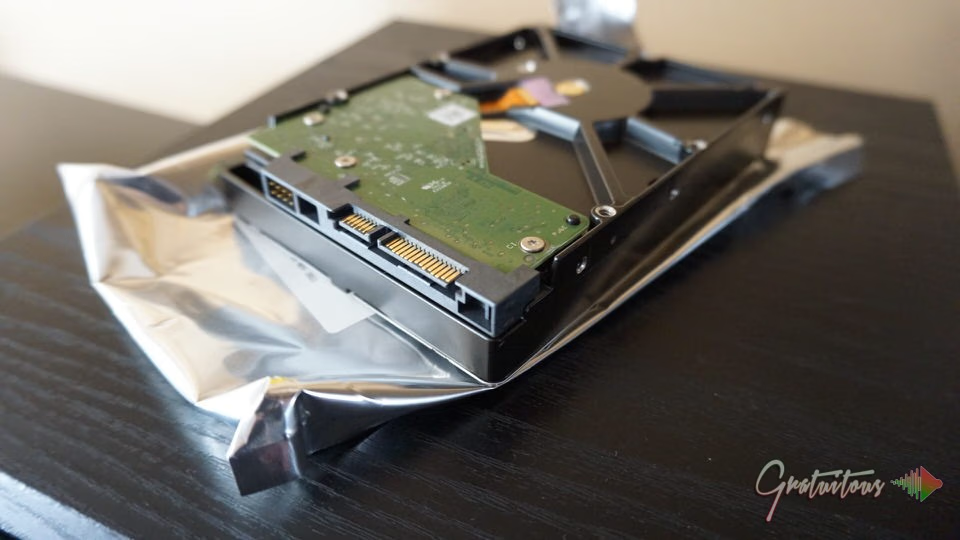
Western Digital Internal Hard Drive (HDD) - Right Angle
This was my Western Digital Black HDD I talked about being a bit loud.. it’s 7200RPM (Works great, but loud).

A mechanical hard drive is more affordable, and is able to be purchased with LOTS of storage space.

You simply provide a power cable from your computer’s power supply (PSU), and a SATA cable plugs into the HDD and motherboard for the data connections.

As I said in this episode, I liked the 5400RPM hard drive, as the noise was not audible in my acoustic computer case to help keep things quiet.. the 7200RPM can be hard audibly.

Solid State Hard Drives:
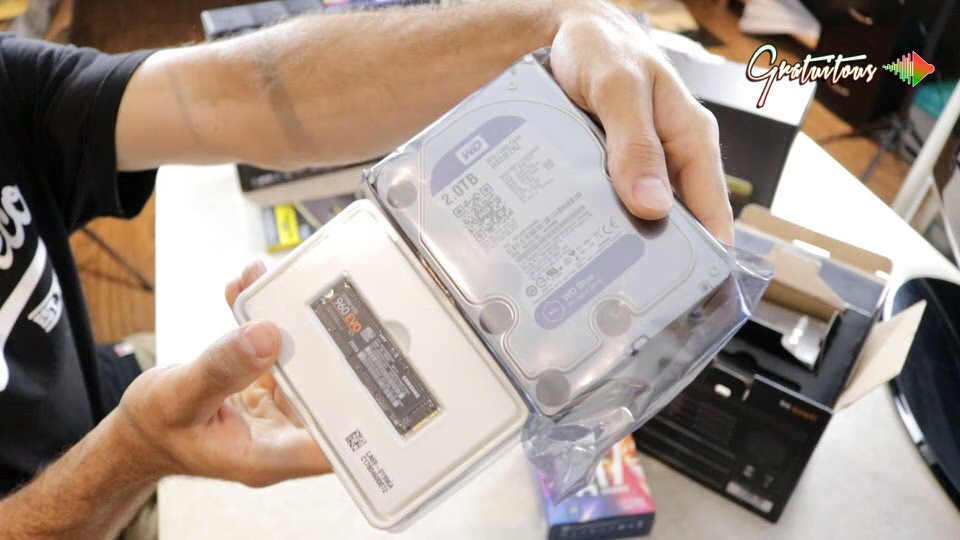
ssd-m.2-form-factor-size-to-hdd
This image is to be used to see the size comparison difference between a SSD with M.2 Form Factor vs. a regular HDD Hard Drive!
ssd-m.2-form-factor-bubble-gum-stick-size
You can see my finger for a size comparison to the bubble gum stick SSD! (Amazing!)

An SSD is what music producers want, and SSDs are becoming more affordable.

At the time of making my music production computer build video, 250GB was like $200-300!!! Now you can get 1TB-2TB for that same price.. (about 5-6 years later..)

SSDs are awesome because they are QUIET and FAST. The only problem at the moment is you can’t buy them in LARGER sizes like 4TB or 8TB (maybe in the old card-type SSDs).. but they are still pricey.

Conclusion.. Hard Drives for Music Producers

So I hope the gives you insight to buying hard drives as a music producer.

Currently we use an SSD for our main C:\ drive which is where we install our operating system (Windows for example), and our most important programs and files like FL Studio, Drum Kits, and our main VSTs.

For our LARGER files (like my FL Studio courses), we store these on a HDD (Hard Drive) because it’s more affordable.

Hopefully in the coming years we will be able to just use one hard drive again, but this time on a fast SSD that is affordable, with a reasonable capacity to keep up with all our digital assets nowadays..

By the way, you can checkout my FL Studio Books if you’d like to become a better producer!

Community

Questions about this episode

Transcript

S2E23 – Different Hard Drive Types for Music Producers

  1. Season two, episode 23, different hard drive types.
  2. All right, this is really important to understand when you are wanting to buy a
  3. music production computer because the current state of the industry is we kind of
  4. still need that solid state hard drive for our main operating system drive where
  5. we're we're you know we're installing Windows or you know installing FL Studio,
  6. installing our you know plugins, stuff like that.
  7. You know, typically that goes on the C drive for that fast performance, everything's
  8. quick to load. But when it comes to our larger files, for example, like really
  9. really big VSTs, or let's say you you have like a music library that you like to
  10. personally listen to, or for me, like if I create videos and courses, like you know,
  11. that stuff's a bit bigger. I offload that onto like the mechanical hard drive, it
  12. doesn't need to be on the expense of solid state drive.
  13. All right, so I'm gonna talk to you about solid state drives, mechanical drives, and
  14. some things to know that I've learned over the years.
  15. And before we get into it, definitely check out my free book I have for you.
  16. It's called Five Keys to a Successful Beat.
  17. It's gonna teach you valuable tips all from an FL Studio producer's point of view.
  18. To download it, you can just go to it's gratuitous.com forward slash five keys.
  19. Again, don't forget to check out the website.
  20. I understand a lot of you guys like this podcast, you listen to it, but visit the
  21. website, it's gratuitous.com. That's where I release my videos, articles, books,
  22. courses, and there's also lessons on there too.
  23. If you're looking for some lessons.
  24. Now, let's talk about hard drives.
  25. Okay, so I want to talk about a mechanical hard drive before we talk about a solid
  26. state. A solid state drive is newer, obviously, yes, it's it's faster, but it is
  27. more expensive. And I believe that the cap right now is at like two terabytes, so
  28. you can't really buy a solid state drive bigger than two terabytes.
  29. I did see like a brand for like four terabytes, but there wasn't too many, okay.
  30. Okay, so about two terabytes is like the max, and so that's why we're kind of having
  31. to balance the solid state for the main operating system and then a hard drive for.
  32. our kind of other files that aren't priority that we don't really need to load fast
  33. In my computer, I built a custom music production computer.
  34. And if you've been following for a bit, I've had this computer since about 2017.
  35. I had a video showing how I built it.
  36. I picked all the custom parts, and it also is an acoustically treated case because
  37. with music production, silence is so important with your computer.
  38. So I had a Western digital blue for my hard drive.
  39. Now there's two main brands there's Western Digital and Seagate.
  40. There's also Toshiba in there as well.
  41. I like the way how Western Digital approaches selling their hard drives, is they
  42. just color code them. And each color signifies what it's for.
  43. For example, some hard drives could be for surveillance systems, right?
  44. Cameras that are continually always writing.
  45. Some are for a NAS, network attached storage.
  46. That color I think is red. I think oh, also the surveillance one I think was purple.
  47. But then there is the black, which is like their performance kind of like gaming,
  48. but it's loud. There's also the Western Digital Blue, which is a slower drive,
  49. less warranty. That's what I had previously, and I really really liked it.
  50. Selecting the right mechanical hard drive is very important for music production and
  51. essentially just even using your computer.
  52. Because again, are you using it for the surveillance system?
  53. Are you using it for network attached storage?
  54. Because those types of hard drives can be loud, they can actually be clicking.
  55. Okay, so my current state, because I upgraded to a mechanical hard drive, I upgraded
  56. to a Western Digital black. The problem with it is that it's just loud, it works
  57. really good. It's a 7200 RPM, which means it spins quite fast, and that's what I'm
  58. hearing, even in an acoustically treated computer case..
  59. And so it's kind of annoying Now you're not going to hear it in this podcast, even
  60. though the microphone is about, I'd say three, three or four feet from my computer.
  61. But what I'm trying to say is that you know it's loud.
  62. And I don't like that. Now, when you are purchasing a better hard drive, such as
  63. like the black, I believe the warranty is better.
  64. And so, you know, the company is essentially saying we believe this hard drive is
  65. built better. It's meant to last longer.
  66. Now, the Western Digital Blue, I believe it has a less warranty, which means you
  67. know the company is saying that they don't really stand behind it as well as let's
  68. say, you know, one of the other products with a longer warranty.
  69. But the Western Digital Blue, why I liked it was again, it was a 5400 RPM hard disk,
  70. you know, a disc that spins. Because, you know, that's that's what it is.
  71. That's what the old hard drives were.
  72. They spin and they're loud. Now the 5400 I never heard at all.
  73. I had a great experience with it.
  74. Again, it just kind of went to sleep sometimes.
  75. So, for example, if I was in FL Studio and I clicked on a sound, sometimes it would
  76. take an extra second or two. I guess it would spin up, then it would load the sound.
  77. And then from that point on, clicking sounds was all super super fast.
  78. Everything was good. It was just kind of like that brief moment where you know, I
  79. clicked, and I really do think it was maybe just a setting within the hard drive
  80. that I believe in Windows, I probably could have just made it 100% always alive kind
  81. of thing, like not go to sleep.
  82. Now, Western Digital also has like a green drive that's supposedly for like just
  83. like storage and stuff like that.
  84. but again, like when if you go to Seagate and Toshiba, they all have like their
  85. different product lines. All right.
  86. So, what I want to say essentially is for our main hard drive, we're gonna be using
  87. a solid st.ate, which I'll talk about in just in just a second
  88. But for that backup drive, you know that we are offloading a lot of things, such as
  89. like you know, our our big VSTs, and one thing I do want to say about that is when
  90. it comes to our VSTs and our sounds, I always like things to be super super
  91. lightweight. And one thing that I got caught on with gearlust is East
  92. West sounds, all right. So, East West sounds creates a extremely high quality
  93. sounds, but in my opinion, they're really catered towards film, right?
  94. Like, you know, film music. The one product I purchased from them was like 40
  95. gigabytes, and I believe you can get like a gold, silver, and like a platinum, or
  96. like they have like these different tiers where like you can go from like 40
  97. gigabytes to 80 gigabytes, like 120 gigabytes just for one plug-in.
  98. And to me, like that is huge. And the problem is is like you always have to bring
  99. that around with you, and so that one plug-in I purchased from East West Sounds is
  100. bigger than all of my sounds together.
  101. Yes, this includes VSTs and one-shot drum samples.
  102. So just being wise with your sounds, you know, the sounds that you're always
  103. bringing in, and I mean sounds is in yes, your drum kits, but also you know, your
  104. virtual instruments as well as your VSTs, you know, your your effects, because you
  105. don't want to always have it be heavy, right?
  106. You know, the heavier your your files are, the bigger the hard drive has to be, and
  107. all that stuff. If you keep things simple, and yes, you still want to get high
  108. quality stuff, but you don't need to be getting like these huge libraries, like it's
  109. just not worth it, in my opinion.
  110. Okay, so now let's talk about solid state hard drives.
  111. So, again, the current state of the industry is just a solid state hard drive, it's
  112. just quite expensive for the size that you're getting.
  113. Now, when it comes to a solid state hard drive, what kind of sucks is I believe it's
  114. kind of capped at like two terabytes.
  115. And I saw a brand out there that is offering four terabytes, but generally, like two
  116. terabytes is like the max you're gonna get.
  117. So that kind of leaves us having to buy two hard drives, right?
  118. We want that solid state hard drive for the main operating system, things like
  119. Windows. If you use Windows, FL Studio, you know, your VSTs and all that kind of
  120. stuff. It all goes onto the solid state hard drive so that when you open them up,
  121. they load very, very quick. When you turn on your computer, it loads very, very
  122. quick. A solid state hard drive, what makes it so beneficial is that there's no
  123. moving parts. So even in that blue Western Digital Blue, the mechanical, the 5400
  124. RPM, you know, even though it spins slower, it still vibrates, right?
  125. You know, there's still just noise, like even if you're not really hearing it, it's
  126. still generating noise. A solid state hard drive does not, and that's why it's so
  127. awesome, right? In addition, they're super super fast.
  128. Now, when it comes to solid state drives, they have been around for quite a while
  129. now, so they're still pretty new to the industry, and the prices have come down, but
  130. they're still pretty expensive.
  131. Now, when they first came out, they came out with like a little rectangle version,
  132. okay, and it was like SATA, and so what that means is that you just plug it into the
  133. mother motherboard through a cable, and again, but you are getting that quietness
  134. and fast speed, and for music production, you know, we've always been even using a
  135. mechanical hard drive. So, mechanical hard drives are sufficient for music
  136. production because typically everything is based off of your CPU, off of your RAM,
  137. stuff like that, okay. Okay, not so much like the hard drive.
  138. And so, any solid state hard drive you get for music production is gonna give you an
  139. amazing experience. The biggest hindrance of a solid state hard drive is just the
  140. capacity, how much stuff. you can store on that solid state drive
  141. Because if I had a choice, I would really like to just buy like a four or or eight
  142. terabyte solid state drive that isn't like five or six hundred dollars, right?
  143. And use only one hard drive. So that in other words, everything would be super fast
  144. on the computer. But again, the industry isn't really like that.
  145. So again, the solid state hard drive we are installing all of our main files on, and
  146. then the mechanical drive, we are offloading things that we don't want to store on
  147. the solid state, such as if you have like a music library that you just like to
  148. listen to, or for example, if I create courses and like there's tons of videos,
  149. right? So those can be quite big on file size.
  150. So I don't put those on the solid state.
  151. So again, there's the square solid state hard drive, and that's what really first
  152. came out. Now there's a new form factor, and it's actually been around for quite a
  153. while. It's like the bubblegum stick form factor.
  154. I believe it's called M.2. But you got to be quite careful here because in the
  155. M.2 form factor, and it again literally looks like a piece of bubblegum, like you
  156. know, if Juicy Fruit, when you used to pull out the little stick, it had like little
  157. tinfoil wrapper, it's literally like that big in size, so it's super super small.
  158. And so there is a SATA version of these M.2 form factors.
  159. There's also an NVMe. The SATA version is the slower version, the NVMe is the faster
  160. version, but at the end of the day, you are still getting great performance compared
  161. to a hard mechanical hard drive.
  162. But if you have a choice, you would probably want the NVMe for the speed, right?
  163. You know, if you're gonna be paying that price, anyways, and the really, really high
  164. performance ones even have like heat sinks on them.
  165. So if you're really doing heavy file transfers and/or like maybe heavy video editing
  166. or whatever to really cause it to run hard, they even have heat sinks on them
  167. nowadays. So anyway, so that's this episode about hard drives.
  168. I mainly wanted to talk to you about the mechanical hard drive because hey, that's
  169. kind of the way the industry is still right now.
  170. We still need a mechanical drive for offloading a lot of these files that we don't
  171. want on the solid state. I am not too happy with the Western Digital Black just
  172. because of its loud. Now, in terms of performance, it's great.
  173. If you were going to be using it for you know, whatever for anything else, that's
  174. fine. But in studio use, I find that the 7200 is a bit loud.
  175. Now, I don't know if that's so much just Western Digital Black or just the fact that
  176. it's a 7200 RPM hard drive. So when I had the 5400 Western Digital
  177. Blue, I was super happy with it.
  178. just went to sleep. As soon as I would click a sound, I'd wait a second or two.
  179. Once it was up and running, it was good for as long as I was using the computer.
  180. but I'm sure again there was a setting to turn off sleep mode essentially for the
  181. hard drive. For the solid state hard drive, again, it doesn't make noise, super
  182. super fast. The very first versions of them were like the little squares, and you
  183. can honestly just buy one of those and save some money, and you're still gonna get
  184. an amazing experience because it's way faster than a mechanical hard drive.
  185. Hopefully, we see some changes in the industry here soon.
  186. That a solid state hard drive comes in a larger format at a little bit more of a for
  187. affordable price. It would just make life way easier.
  188. Because when I you know, when I was younger, when I was using a computer, you know,
  189. when I just remember everything was just one hard drive, it was just simple,
  190. everything was easy for backup purposes, everything was just one drive.
  191. As soon as the two drives get split up, kind of gets a little bit trickier when it
  192. comes to backing up your files, file management, where to put files.
  193. and that's just what I have felt over the years.
  194. So I hope that helps. If you guys ever have questions about purchasing a music
  195. production computer, always feel free to reach out.
  196. the biggest thing that FL Studio says is you want to be purchasing a CPU with a fast
  197. single core speed. And nowadays, a lot of these CPUs they have multiple cores.
  198. So I'm running on four cores right now, but they have like eight, twelve
  199. cores, I think there's even like 16 cores, and obviously getting more
  200. expensive. All right, so I hope this saves you some money out there.
  201. If you have to purchase a new hard drive or if you're in the middle of purchasing a
  202. music production computer, it's kind of just the way the industry is right now.
  203. But I hope that allows you to make wise choice to have a nice quiet computer that
  204. you enjoy because I hear noise and it's not very
  205. enjoyable. So that's it for this episode.
  206. Again, definitely check out my website, it's gratuitous.com.
  207. That's where all the tutorials are, all the books, all the courses.
  208. And again, if you're looking for some lessons, you guys can do that too.
  209. Don't forget about my free book I've written for you guys.
  210. It's for FL Studio Producers. Just go to it's gratuitous.com forward slash five
  211. keys. The book is called Five Keys to a Successful Beat.
  212. So simple it becomes creative.
  213. The book is all about teaching you guys that music production doesn't have to be
  214. hard, it's actually quite simple, but people make it very intense.
  215. One thing I'll tell you guys is I have been involved in quite a few different
  216. industries in my life so far..
  217. And in the music industry, people they really think they're like super super smart
  218. And the thing is, I understand there's a lot to know within music production, but it
  219. doesn't have to be super intense.
  220. All right. The biggest thing is learning how to make a beat.
  221. And if you let the knowledge overcome that, it's not gonna be fun.
  222. Okay. Making a beat is not something everybody can do.
  223. You want to get to the point where you can make a beat.
  224. It doesn't matter, you know, when it comes to, oh, is this the best limiter, or oh,
  225. is that the best limiter? And when it comes to the limiter, like even I was reading
  226. the the help manual of Fab Filters Pro L2, and I want to read more about the
  227. advanced sections, such as like when it comes to the look ahead, the attack, the
  228. release, right? Like, how do these really affect our audio?
  229. And I will sure let you guys know in time coming.
  230. But as you can see, that that stuff's so intense, you have to read, it's really
  231. really like you know, it's overwhelming, and everyone just wants to sit down, make
  232. the beat, and have fun and produce the highest possible quality without getting
  233. super nerdy, and like I said, it's really easy to be overcome and
  234. think that you need all this knowledge.
  235. Now, you need a lot of knowledge to become a good music producer.
  236. That's not what I'm saying. But what I am saying is if you are letting the knowledge
  237. overtake your enjoyment, and you still don't really know how to make a good beat
  238. yet, you need to learn to make a good beat, and then it all comes into play and it's
  239. still fun. Okay, so I'll talk to you guys in the next
  240. episode.
GratuiTous Radio Start free Join Membership 0:00/0:00