Spend $50, get $25 OFF — applied automatically.
Skip to Content Skip to Navigation Skip to Footer
Join Membership
Season 2 ·

S2E22 – The Secrets of 808s as a Beatmaker
0:00 / 0:00
This media could not be played.

Never Miss an Episode

Get new podcast episodes delivered to your inbox.

Home/Podcast/S2E22 – The Secrets of 808s...

It doesn’t matter what genre of beats you make, the 808 is one of the most powerful instruments as a beatmaker.

Now, the 808 is a VERY SPECIAL instrument because it’s like a hybrid between an kick drum and a bassline.

It has the initial HIT (like a short-tailed drum gives you from Urban Heat Drum Kit), but then it has a tail which is like your bassline! Because it has both the kick drum and bassline sound inside one sound, it allows us as producers to be VERY creative with an 808 and use it as a melody, while sounding VERY FULL in the low-end of the track.

Now, typically I don’t use an 808 and a bassline together just because it makes mixing tricky. You can do this, but you will just have to be creative in how you’re adjusting EQ when mixing 808’s and basslines.

Also, being wise in your sound selection when choosing kick drums will also make your mixing easier.

Finally, here’s a picture I will leave you where I was talking about using a short-tailed drum to hit you in the chest, then on the 808, in the Channel Sampler in FL Studio, under the “Envelope / instrument settings”, under “Volume”, you will want to enable the Envelope circle button:
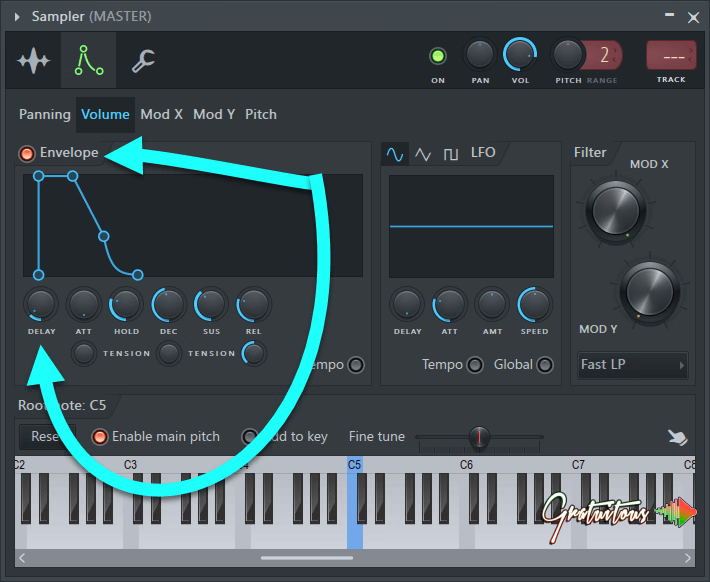
Enable Volume Envelope in Channel Sampler for a Clean 808 Sound
If you increase the delay knob on your sampled 808, it allows your short-tailed drum to hit HARD, and then the 808 will come in. It’s like the “poor-man’s sidechain compression”.. but allows for tons of flexibility.

Community

Questions about this episode

Transcript

S2E22 – The Secrets of 808s as a Beatmaker

  1. Alright. Season two, episode 22: The Secrets of 808s as a
  2. Beatmaker. Now, I just released a tutorial about how to use 808s,
  3. a beginner's guide. I will leave the link on the episode resource page for season
  4. two, episode 22. And an 808, if you don't know about an 808, and if you've never
  5. practiced using an 808, I highly suggest that you always just tinker around with an
  6. 808. It is by far probably one of the most versatile
  7. tools as a beatmaker. Okay. Now an 808, the history of an 808 is it
  8. actually came from what's called a Roland TR808.
  9. It's an old school drum machine, it's a highly sought-after drum machine.
  10. And not only do you have like kick drums, it had like kicks, claps,
  11. snares, hi-hats, cymbals, rim shots, cowbell, has all these kind of original sounds,
  12. and I'll play a couple of those for you right now just so you can hear
  13. them.
  14. And so those types of sounds you will hear even in today's style of music.
  15. People sometimes like to bring that old style of music back into new music.
  16. But this 808 is really, really special.
  17. Now, the 808 has evolved tremendously from when it originally
  18. happened, right? To this TR808.
  19. And again, it's created by Roland.
  20. And I highly suggest that you go to Wikipedia, look it up, read a little history on
  21. it. Okay, it's a very, very cool machine.
  22. And so, why an 808 is so powerful, I actually consider an 808 like
  23. an instrument. It is both a kick drum, so it has the initial hit of a kick.
  24. It's like right, but then it has that tail and it's super low
  25. frequencies., and And now when you are going to make a beat usually how I would work
  26. is I have a kick drum an 808, or I have a kick drum and a bass line.
  27. I usually don't have a bass line and an 808.
  28. I have made tracks that I do, but it makes the mixing more tricky and a little more
  29. involved because again, in that low end, there's only so much space for these
  30. different sounds like kick drums and 808s and bass lines for them to go into.
  31. And especially because they're lower frequencies, they're slower moving, the
  32. clashing can really be audible.
  33. So before we go further about 808s, definitely check out my free book I've written
  34. for you guys. It is called Five Keys to a Successful Beat.
  35. So simple, it becomes creative.
  36. Just go to it's gratuitous.com forward slash five keys.
  37. You can download the book absolutely free by entering in your name and email.
  38. Tons of valuable tips in there.
  39. Now again, I have a free tutorial I just released about 808s, and I cover tons and
  40. tons of stuff. Okay, I highly suggest you watch it.
  41. You will learn a lot. A couple things I want to talk to you about based off of that
  42. tutorial is that we have a sample based 808.
  43. And so what that means is let's say we had that roll in TR808 drum machine.
  44. Someone records the kick drum into the computer, all right.
  45. And it's a single file that you can purchase or you can find them online, right?
  46. So you can have this one shot 808 drum sample.
  47. Again, the 808 is kind of like a kick drum and a bass line, depending on the style
  48. of 808 that you have. An 808 can not have that transient.
  49. It can have more of just the tail.
  50. And this is also very common. a lot of more trap music producers, a common technique
  51. they often used was they would get their own kick drum, which hits super super
  52. hard, right? It has that hit, it hits you in the chest, a short-tailed drum, right?
  53. So on my website, there is what's called the drum bundle trio.
  54. It comes with three drum kits: urban heat, organic drum kit, and survival drum kit.
  55. All right. The bundle gives you over 2300 drum samples.
  56. Now, these are just one-shot drum samples for your kicks, your claps, your snares,
  57. your hi-hats, percussion. It does, it just allows you to be really, really versatile
  58. as a music producer, okay. Now, inside that bundle, there is urban heat drum kit,
  59. which is also available by itself, and it has 808s.
  60. Now, these 808s are really cool because they're really unique, right?
  61. Some of them have that initial hit for that kick drum, some of them have more of
  62. just you know, it focuses on like the low end tail of the 808.
  63. But what I wanted to say was these trap producers, what they often do is they get a
  64. short-tailed drum, which is an urban heat as well.
  65. So a short-tailed drum is super powerful because it's short and it focuses on
  66. essentially just hitting you in the chest super hard.
  67. And it's really beneficial to use a short-tailed kick drum if you are going to be
  68. using an 808 or a bass line because it's a lot easier to mix, it cuts through the
  69. mix a lot harder. And then even if you do side chain compression to just help the
  70. bass duck a little bit from the other, you know, baseline or 808.
  71. That kick drum, it just happens so quick, it just still allows your mix to be nice
  72. and full. But what they would do is inside of FL Studio, when you go to your channel
  73. sampler, you're gonna click the envelope and instrument settings.
  74. Okay. And so, what they would do is under volume, they would enable the envelope.
  75. And if this was the 808, they would put the attack all the way at zero, and they
  76. would put the delay. up a little bit
  77. And so what this is doing is that they would be able to use their short-tailed kick
  78. drum, and then the 808 would play just in time so it didn't sound like it was
  79. delayed. Okay, so I'll repeat that again.
  80. So they would have a short-tailed kick drum that hits you super hard on the chest.
  81. But this 808, what they would do is they would enable the envelope, they would put
  82. the attack to zero, and they would increase the delay.
  83. So in other words, when the 808 plays, there's actually a bit of delay there so that
  84. it allows the short-tailed drum just to hit super hard, essentially as if like
  85. you're doing side chain compression.
  86. But this is kind of like the poor man's approach to side chain compression, but
  87. it's actually more powerful than side chain compression because it's like you can
  88. totally fine-tune the envelope.
  89. All right, so that's one little pro tip that I used to always see a lot of trap
  90. producers do. for myself, I would probably just do side chain compression.
  91. It just kind of I usually like having that control of side chain compression in a
  92. sense of it just allows it to duck as much as you want.
  93. You can still kind of have the bass there, it's just not clashing as much.
  94. but again, it's all it's all up to you on how you want to approach that.
  95. Now, again, if someone is gonna record an 808 and you have it into a drum pack, like
  96. I was trying to explain, right?
  97. Let's say that exclusive audio drum bundle trio, those are all one-shot drum
  98. samples. They are recorded into a sample, and so there's pros and cons to a
  99. sample, okay? So it's recorded into a file, it's a high quality file, but the
  100. problem is if you're wanting to go up or down the frequency spectrum.
  101. So, in other words, instead of playing C5 on that note, because when we are clicking
  102. our notes in into the channel rack inside of FO Studio, right?.
  103. So let's say we're making a drum loop
  104. Whenever you're clicking in a step, that is actually playing C5.
  105. So in other words, it is playing the sound in its original pitch.
  106. All right. As soon as you start going up or down, the computer has to resample
  107. and your pitch goes up or goes down.
  108. And when you go up in pitch, you will notice that the note gets much shorter.
  109. Okay. If you go down lower, the note gets much longer, but it's like so.
  110. I'll let you hear an example. Okay.
  111. Here is a normal clap. Here is that clap pitched up.
  112. And here is that clap way pitched down.
  113. All right. And then here is the clap again.
  114. So that's what happens with a sample.
  115. All right. Someone's recorded that.
  116. It's in a single file, and now it's in a drum kit that pack that you can buy, right?
  117. Now, when I'm making my drum loop, typically my kick drum, my clap, my hi hat, I'm
  118. not really going up and down in pitch too much.
  119. And if I am, very often it's only up maybe one or two notes or down two notes, you
  120. know, maybe just to fine-tune it a little bit.
  121. If I am going way up or way down, it is for a sound design purpose, and I'm trying
  122. to find a really unique sound.
  123. Okay, but typically I'm trying to use these samples inside the drum kit as their
  124. original pitch because that's the highest quality.
  125. All right. And so when it comes to the 808, if you are going to select a sample
  126. based 808, and you're going to use it, you can really only go up and down so much
  127. until that 808 is starting to sound quite weird.
  128. Okay. Because again, it's a sample, and as it goes up and down in pitch, it's just
  129. sounding a little gross. Okay.
  130. You're not getting that high quality sound like you can be getting if you're using a
  131. virtual instrument. So if you're gonna use a virtual instrument for an 808, if you
  132. go up and down pitch, see because it's what's called synthesized, and essentially,
  133. in other words, it's it's mathematical, right?
  134. When we use a synth, if you go up and down, it's just math, and you're getting the
  135. highest quality of any sound, right?
  136. If you are using a synth and you're playing your melodies up high, or if you play
  137. your melodies down low, yes, it is up higher pitch, and yes, it is down lower pitch,
  138. but it's not like that clap example I gave you.
  139. Now, what I'm trying to say is if you're gonna use an 808, if you try something like
  140. Flex, there is a bank there and it has tons of different 808s.
  141. I think it has 25 different presets.
  142. It's under the mobile tuned 808 bass inside of flex.
  143. Now, inside of this bank, in my opinion, there's probably only a handful that I
  144. really like to use. I typically always like an 808 that's really nice and clean
  145. sounding. So I usually like it to have a nice kick drum sound to it, and that's you
  146. know, kind of what you call like the transient, the initial hit of that 808, like
  147. the right? But then the tail is also very important, and as you go through a couple
  148. of these ones in flex, what you'll hear is some of them have that nice hit and nice
  149. tail, and they're nice and clean, like they're not overly distorted.
  150. There's some where it doesn't have much of that kick, you know, so it doesn't really
  151. have that it'd be more of just kind of like you know, it's it's just a very long
  152. tail. Again, it all comes down to the style of music you're making and what you're
  153. wanting to do with it. But typically, I like that 808 to have that initial hit, and
  154. then you have that tail, and the benefit of that is you can apply your own
  155. distortion to to it. it, fine-tune it however you want, and just be able just have
  156. total control over And another thing, when you are using a virtual instrument for
  157. your 808s, you want to be adjusting your sustain and your decay to make the
  158. 808 feel a little bit more natural.
  159. Otherwise, that 808, if you hold down the note, like it's just gonna be constant.
  160. And in my opinion, whenever you are mixing your 808s and stuff like that, it's
  161. always nice to be able to have a little bit of life in them.
  162. And when when we say life when it comes to music, it's just a little bit of like up
  163. and down, a little bit of movement.
  164. If your sound is just so constant and so consistent, it just makes your, you know,
  165. like your, especially like your bass, right?
  166. It just makes it so steady. In the 808 pack, there is the 808 synth boosted and the
  167. 808 synth clean. They're they are near the bottom.
  168. I would suggest selecting one of those and playing with them.
  169. you can bring your sustain down quite a bit.
  170. And what you'll notice is you get more of like that that like more of like the more
  171. of like the actual kick drum. And when you hold down the note, it's still there, but
  172. it's not like the same. And one final thing is the release.
  173. Okay. So the release is when you let go of that note, it allows the 808 to play a
  174. little bit longer. And if you don't adjust the release, like if you just select the
  175. preset, when you press a note and let go of it, it's pretty quick and abrupt
  176. sounding. So definitely adjust some release on these 808s when you're using flex,
  177. and you're gonna give your 808s a lot more life and allow them to be more of like a
  178. bass line, something that you can kind of play around with, and it kind of moves
  179. more with your beat, is what I find.
  180. So, quick recap about an 808. Again, definitely check out the free tutorial I have
  181. for you.. It's very in-depth It shows you tons of different things, such as just
  182. like I talked about like what is an 808, where does it come from?
  183. So it comes from that roll in TR 808.
  184. When it comes to an 808 inside of FL Studio, if it is a sample, I always tell you
  185. guys use those in and out knobs, right?
  186. I'll talk about that inside the membership in the platform there.
  187. the in and out knobs when you're doing sound design is by far one of the most
  188. powerful things in FL Studio to fine-tune that sound because the problem with an 808
  189. is again the tail can be so long and you can fine-tune it with that out knob.
  190. All right, so be on the lookout for more tutorials based on 808s.
  191. I want to cover how to glide 808s.
  192. I talk about it in that tutorial, but I want to come up with like shorter videos, a
  193. little easier to digest. So if you guys don't want to miss any of that stuff, you
  194. guys can sign up to the email list, right?
  195. And you do that by downloading my free book, Five Keys to a Successful Beat.
  196. Just go to it'sgratuitous.com forward slash five keys.
  197. Again, you guys can check out the show notes, the resources, and all the information
  198. will be in there. You can visit the website, and I have tons and tons of courses,
  199. books, and tons of free articles and tutorials.
  200. Okay. So I highly suggest you guys to use the search bar on my website, okay?
  201. Just go to it's gratuitous.com.
  202. Any question you have, like if you're looking if you want to learn about drum loops
  203. or learn about piano or learn about whatever, just type in those keywords into the
  204. search bar. And I have tons of articles.
  205. I have many old articles. My goal is to update them all eventually, one day at a
  206. time, though, right? So thanks for checking out this episode.
  207. And I hope you guys enjoy the beat.
  208. I played it in the tutorial. It's called You Go Girl.
  209. It was really, really funny when I made the beat.
  210. my mom was actually sitting beside me, and I always tell my mom you go girl, like
  211. just like for encouragement, but we also joke around because it's kind of funny when
  212. people say you go girl, right?
  213. And so I was teaching her about an 808.
  214. because my mom is she's kind of in tune with like the music, like with the music
  215. production because whenever I write books, she is the editor, like you know, she
  216. edits the books, she doesn't fully understand what's going on, but she does edit
  217. them, and so she likes to kind of learn new things.
  218. And I was explaining what is an 808 to my mom.
  219. I told her, you know, it comes from the classic TR808 drum machine.
  220. I literally listen to a couple different 808 sounds and how different they can sound
  221. over the years, right? So, again, if it's coming from that actual drum machine, it
  222. has a a bit of a different sound than what we're used to when it comes to an 808
  223. today. But anyway, so I made this drum loop with her, and my mom, she was kind of
  224. like, Oh, I don't really like that, and then I played this little guitar loop over
  225. it, and I'll play this at the end of the at the end of this episode.
  226. You can hear the beat. and then just because I always say to my mom, you go girl, I
  227. called the track name you go girl, and then we were joking around, and I ended up
  228. throwing some voices over top of it saying you go girl, and it turned out pretty
  229. funny. All right, so I'll play that and I'll talk to you guys in the next episode.
  230. That's right.
  231. Oh no,
  232. five.
  233. You go girl.
  234. You go girl. That's right.
GratuiTous Radio Start free Join Membership 0:00/0:00