Spend $50, get $25 OFF — applied automatically.
Skip to Content Skip to Navigation Skip to Footer
Join Membership
Season 2 ·

S2E05 – EXAMPLES of Low-End Bass Clashing
0:00 / 0:00
This media could not be played.

Never Miss an Episode

Get new podcast episodes delivered to your inbox.

Home/Podcast/S2E05 – EXAMPLES of Low-End Bass...
Get the Drum Samples.. They are AWESOME!
Learn to Make Drum Loops Book

The low-end of your song is make-it-or-break-it.

If your low-end sucks, you song will never be at its BEST!

It honestly comes down to wise sound selection to achieve the absolute best sounding mix, but wise sound selection is also luck of the draw.. you cannot perfectly select the right sounds every beat.. you can be mindful of it, but when the right sound selection does happen, you will instantly know it… your beat becomes much easier to mix, the arrangement just works, and the beat is more fun to work with than usual.

In this episode, we build off the previous S2E4 on SHORT-TAILED and LONG-TAILED DRUMS. I wanted to now break down how low-end bass sounds when it clashes.

When you play a kick drum with a long-tail too fast, its tail overlaps on itself, and essentially a bunch of duplicated audio gets played for a short bit until all drums are done playing. (The example was hard to hear in this example, sorry, but there was a difference.)

This instantly messes up your song’s bass, and overall balance of your mix, because the bass will either be WAY louder for a second, or it entirely skews the low-ends phase response.. giving you that horrible wobble sound.

The final example I gave you is when we use different notes on our bass that overlap.

This overlap can happen if the RELEASE is TOO LONG on our BASS’s ADSR when we talk about sound design, or it can be when we change notes on our 808’s.

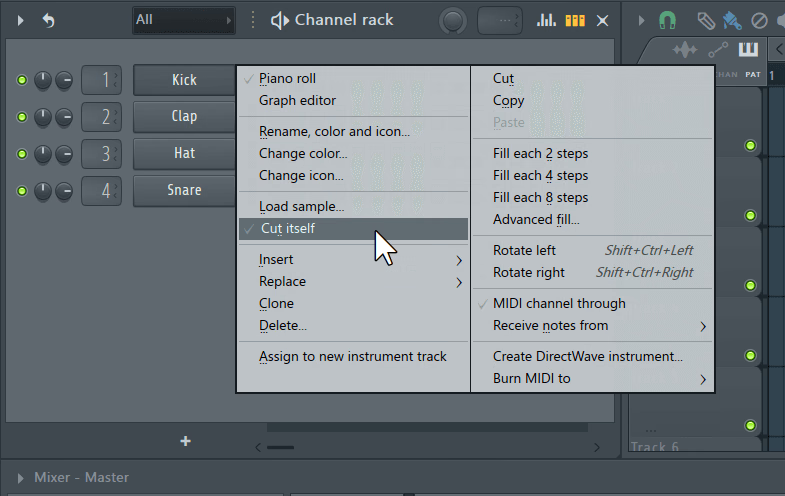
To prevent bass overlap, we can use Cut Itself.. it’s really easy in FL Studio.. simply right-click any sound in the Channel Rack, and select Cut Itself.
Community

Questions about this episode

Transcript

S2E05 – EXAMPLES of Low-End Bass Clashing

  1. Season two, episode five. Examples of low end
  2. bass clashing. Alright, we're gonna get more in-depth of the previous episode.
  3. So if you have not listened to the previous episode, make sure to go back to episode
  4. four inside season two here. And it's important that you guys are wearing either
  5. headphones, earbuds, or listening to this in your studio on your
  6. speakers. You need to hear the low end.
  7. If you're on a cell phone, this episode is not gonna help you, okay.
  8. The reason is because cell phones do not produce this low end bass, which I'm gonna
  9. show you, right? 50 hertz, 60 hertz, 70 hertz.
  10. I'm gonna give you examples of the low end clashing, which just sounds horrible and
  11. it wrecks your music. Bass is something that we as producers,
  12. it has to hit tight, it has to hit good, and it has to complete the song, right?
  13. It has to. That's bass. So again, I'm just using the exclusive audio drum bundle
  14. trio. I'm using Urban Heat Drum Kit.
  15. Now, before I show you examples, we also need to talk about that.
  16. I do consider an 808 different than a long-tailed kick.
  17. I would consider an 808 more like a bass line.
  18. Okay, so bass lines and long-tailed kicks can work in the same
  19. song. Sometimes it does take a little bit more mixing or heavier processing, such as
  20. the side chain compression. And if your plugins allow you to do it, such as like a
  21. multi-band compressor, where you can only compress like the low end and you can kind
  22. of still keep the mids to the highs, that's also really powerful too, because many
  23. times the bass line stands out from like the mids to like the mids highs.
  24. Okay. If your bass line is ever struggling to stand out, you can boost around, you
  25. know, maybe that 1k, that 2k, you know, 1000 hertz, 2000 hertz.
  26. You can boost around there.. Many times that helps your baseline stand out a little
  27. bit more Okay. A lot of times the bass is there, except we're not hearing more of
  28. like the high end of it. This is the same with kick drums as well.
  29. You can always boost that click to help that kick drum stand out a little bit more.
  30. All right. Too much bass is also a problem.
  31. And I know, especially when you're new, you know, you always want to mix in like
  32. more bass, more bass, but it's more important to have a nice balanced mix, and then
  33. maybe in the mastering, maybe you can kind of bump that kick drum or that bass up a
  34. little bit, or even near the end of the mix, you can bump it up as well.
  35. So long tailed and short-tailed kicks was the previous episode.
  36. And short-tailed kicks are usually never the problem.
  37. And the reason is because they hit higher in the frequency spectrum, right?
  38. Maybe in the 70s, 80s, stuff like that, maybe the 90s.
  39. And one thing to say about bass, because the numbers are much closer
  40. together, one or two frequencies really makes a difference in the low end.
  41. Like maybe, maybe not one or two frequencies.
  42. But for example, if we go from let's say 50 hertz to 60 hertz, like that's a big
  43. jump, okay, because you have to think proportional wise, like when it comes to
  44. numbers. But now once we go into like the mid frequencies and the high frequencies,
  45. we're talking in the thousands, right?
  46. So 1000 hertz to 100 and 10 hertz isn't a very big change,
  47. is it? But if we go from 50 hertz to 60 hertz, that's 10 hertz difference as well.
  48. And that's a drastic difference, okay.
  49. And so when we have a short-tailed kick, which is hitting more in the again, 70 to
  50. 80s, let's say, it's higher in the frequency range, okay?
  51. So it kind of sits in its own area.
  52. Most of the time it's not going to clash, so it's a nice short-tailed kick, it pops
  53. through.. It's also shortened tail, okay
  54. The longer the tail, it's more audible to our ears.
  55. But if it's nice and quick, that again, that's another reason why the short-tailed
  56. kick gets away with sounding clean in your mix.
  57. So again, two reasons. It's short in length, as well as it hits a little bit higher
  58. in the bass frequencies. So, what I'm trying to say is in the low end, there's
  59. different areas in the low end within the low end itself, right?
  60. So, like let's say from like 45 to like 60 hertz, and then from like 60 hertz to 80
  61. hertz, and then maybe from like 80 hertz to like 150 hertz, okay.
  62. And many times our room doesn't even really allow us to hear this clearly.
  63. And if you are privileged enough to have a good room and be able to hear that, then
  64. you could really mix your music good.
  65. But I'm like most of you, I'm just in a in a bedroom here, and so I gotta work with
  66. what I have, and that's why I go and test on different systems when it comes to
  67. bass, okay. So, with that said, the short-tailed kick can do its own thing.
  68. Now, the long-tailed kick, again, the problem is because it has a longer tail, and
  69. it also plays lower in the frequency spectrum, which can clash with the bass or your
  70. 808, right? Because the bass and an 808 are kind of like the same thing.
  71. Like if I were to make a beat, I would probably never have a baseline with an 808.
  72. And again, it just depends on the type of 808 you're using as well.
  73. But to close out on the long-tailed kick, again, you just got to be mindful of it
  74. because again, it has the long tail as well as it's hitting in that low range with
  75. your 808 or with your bass line.
  76. All right, so let me play this example for you.
  77. Again, this is just an 808, and I pur.posely selected this because it has a super
  78. long tail Now I talked to you in the previous episode about cut itself.
  79. All right. Now, this is what happens if you play your bass line or your 808 drum
  80. too fast. You're gonna hear the bass wobble and it sounds distorted, and the reason
  81. is because it's overlapping. So this is what it sounds
  82. like. Okay. Now I'm
  83. going to enable cut itself, and it sounds like this.
  84. All right, it's way cleaner, right?
  85. Like the initial hits. Now, I would not use an 808, probably like
  86. this, but it's just to show you that the 808 is playing too fast.
  87. And one other thing to say is that this 808 has quite a heavy layer on it.
  88. Okay, it's not like a real organic 808, has a little like a layer in
  89. there, but it does hit hard. Okay, so that's one example.
  90. Now, the next example is when we play different notes.
  91. Okay, because with an 808, that's usually what you do is just like
  92. a bass line, right? That's how you're playing the 808.
  93. You'd go from like C to D to whatever your chord progression is.
  94. That is what your 808 is doing, right?
  95. Your bass line follows the chord progression for the most part.
  96. And so your 808 would be following the chord progression because it's no different
  97. than a bass line. It's in the low lows, and again, it has to be respected for
  98. such. And so now I am playing this 808
  99. without cut itself on, and I'm playing different notes and listen to the horrible
  100. wobble. All right, so now I'm gonna play that with cut itself enabled, and again,
  101. cut itself, all it does is it stops the sound before it.
  102. Okay, so for example, if we're playing this 808 and I'm playing C, D, and E, when C
  103. plays, okay, it's playing, and then when D plays, it immediately stops the C note,
  104. and then D plays and it starts fresh.
  105. And then when E would play, D would stop and E would start fresh.
  106. Okay, so it stops all audio before it allows it to play fresh.
  107. And the reason why that's important is because you don't want it to sound like this.
  108. Sounds horrible, right? You hear that it's like wobbling, okay?
  109. It does not sound clean. So all you have to do is just enable cut itself by right
  110. clicking on the sound. Listen to
  111. this. Much cleaner. You can
  112. easily make a melody with this now.
  113. So let's just recap. You have to make sure to listen to the previous episode to
  114. learn about short-tailed kicks and long-tailed kicks, okay?
  115. And then I talked to you about how I consider an 808 and a bass line to be very,
  116. very similar. Okay, very often they are living in the same frequency spectrum.
  117. And then you have your long tailed kick, which can work with your bass in 808, but
  118. you just got to be careful in when you're playing that sound, as well as you might
  119. have to do heavy processing. And then I wanted to just show you that if you just
  120. played your 808s too fast without cut itself on, what's happening
  121. is every single one of those notes that's playing, even if it's the same note, is
  122. all overlapping. And what happens is it builds up as well as there's lots of phase
  123. cancellation going on as well.
  124. Again, especially because in the low end, because in the low end, let's say 50
  125. hertz, that's going much slower than a thousand hertz.
  126. Okay. So that's why we hear more of a woo-woo that kind of sound.
  127. Whereas when in the high end, even if it does cancel, many times that's
  128. even a sought-after sound. You know, again, that's why we have choruses and phasers
  129. and stuff. That's that's what it's doing, anyways.
  130. Okay. But on the low end, again, that's why they're even saying you want to mix in
  131. mono in the low end. You want to always make sure that low end is clean.
  132. This includes the bass line and the kick drums, okay.
  133. And by following these guidelines, I promise you you will get much better results
  134. out of your low end for your music for sure.
  135. Okay. So I want to leave you guys a couple resources.
  136. So the sounds I used were from the exclusive audio drum bundle trio.
  137. There is so many sounds in here.
  138. This has been a sound kit that I have used, or again, there's there's three sound
  139. kits inside of exclusive audios drum bundle trio.
  140. There's an organic drum kit, survival drum kit, and urban heat drum kit, and they're
  141. all organized. It allows me as a music producer to know where my sounds are when I
  142. want to use that sound. They're very, very high quality, and there's tons and tons
  143. of variety. Again, just check out the episode resources near the bottom.
  144. Okay. Also, if you're wanting to learn about drum loops, if you want to learn how to
  145. make good drum loops, I've created this special curriculum, it's called safe spots.
  146. Creating amazing drum loops. Safe spots actually consists of two parts.
  147. Okay, so it's a book, it walks you through step by step how to make solid drum loops
  148. inside of Eiffel Studio, and it essentially is all about learning about MIDI in
  149. depth, because that's when we as producers program our drum loops.
  150. It's all to do with MIDI. And so Safe Spots has sound placement.
  151. Where can you place your drums?
  152. That was probably the hardest thing for me to learn as a music producer, is learning
  153. where to place my drums. And when it comes to different music, different genres, all
  154. these genres operate a little bit different when it comes to sound placement.
  155. And so if you want to become a good producer, you want to learn different genres in
  156. terms of their drum loops. Now, I didn't say you want to create different genres.
  157. Like, you know, you create whatever you want to create, but it's important for you
  158. to learn the different techniques so that you can apply it to your own music.
  159. Okay. That's a really cool pro tip I can pass on to you.
  160. That's something that I did in my early years.
  161. I remember I learned some, you know, some dance music.
  162. Even in dance music, there's different subgenres, right?
  163. Like trance music, and then even on the hip hop side of things, right?
  164. But then I also talk to you about organic tools.
  165. And these tools are free inside of any music program.
  166. But the thing is a lot of music producers don't know about them, and they always
  167. look towards the fancier tools, which are expensive.
  168. But the tools that I tell you about, the organic tools, it's all based off of MIDI,
  169. and that's what we use to play our melodies in a piano roll, or in the case of FL
  170. Studio with the step sequencer slash channel rack.
  171. And we have full control over our music in terms of let's say you placed a chord
  172. in, right? If you want to change a note in that chord, if you want to make it early
  173. or late, if you're interested in safe spots, just go to it's gratuitous.com forward
  174. slash safe spots, okay? Or just check the episode resources and you guys will find
  175. all the links, okay? So I hope you found this episode valuable.
  176. Learning about bass is extremely important.
  177. I purposely used a long-tailed 808 in this example.
  178. But again, you might be using an 808 in a different way.
  179. There's also short-tailed 808s as well, which is kind of more like a long-tailed
  180. kick now. But at the same time, not really because it's still hitting in that low
  181. end. So you have to be careful on how long the tail is and you know what you're
  182. doing. but the biggest thing is, especially in the low end, is you have to make sure
  183. that the notes that you're playing match.
  184. Okay. So in the low end, usually we cannot play a chord in the low end.
  185. It just doesn't work that way.
  186. The bass is usually single notes.
  187. And again, it's just because the frequencies are so close to each other that we hear
  188. clashing. And that and that's all it is.
  189. But if you go higher up in your octaves, you can easily start playing chords and
  190. they sound good. But again, it's because now one note to the next, it's quite
  191. larger in frequency difference.
  192. Okay, so always keep that in the back of your mind because sound selection, very,
  193. very important as a music producer to know where to place your sounds to make your
  194. mixing easier, to make your music sound fuller.
  195. So just go to it's gratuitous.com forward slash five keys.
  196. I'll send you my free beat making book to your email.
  197. Okay, thanks for checking out the episode.
  198. Feel free to check out the other episodes or just visit the website it's
  199. gratuitous.com. Hey Gratuitous here.
  200. I hope you enjoyed the content.
  201. If you want to become a better producer, then check out my podcast called Music
  202. Production Made Simple. It's totally free and available wherever you listen to
  203. podcasts. I also run a beatmaker trainer platform.
  204. There's over 26 courses in there right now, all focused on FL Studio.
  205. It's helped a lot of students, and I'm sure you'll love it..
  206. For more information, just go to itsgratuitous.com forward slash courses
  207. Finally, if you like to read, all of my books are now available in one bundle, such
  208. as audio painting about arrangement, safe spots about drum loops, FL Studio
  209. Beginners book, which is going to teach you the basics, my template book to teach
  210. you about a fast workflow, as well as proper producer mindset to start your music
  211. production career right the first time.
  212. For more information on my book bundle, just go to it'sgratuitous.com forward slash
  213. books. Thanks again for watching.
  214. Visit it'sgratuitous.com for all your FL Studio training
  215. needs.
GratuiTous Radio Start free Join Membership 0:00/0:00